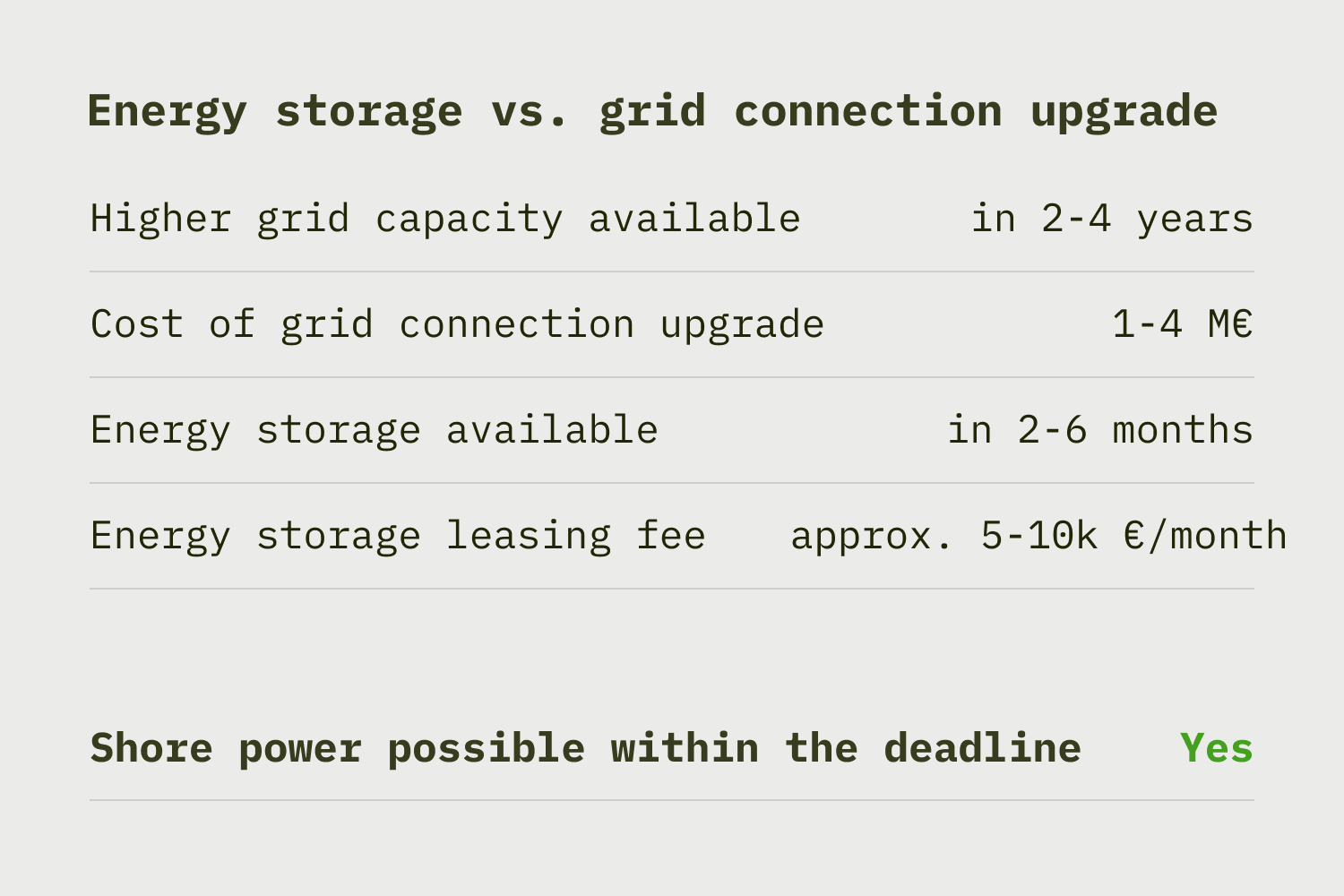
TEN-T ports must offer shore power to container and passenger vessels by 1 January 2030. This means a significant increase in power demand at ports. With a Cactos energy storage system, you can enable shore power even when your grid connection is insufficient.
How energy storage helps you


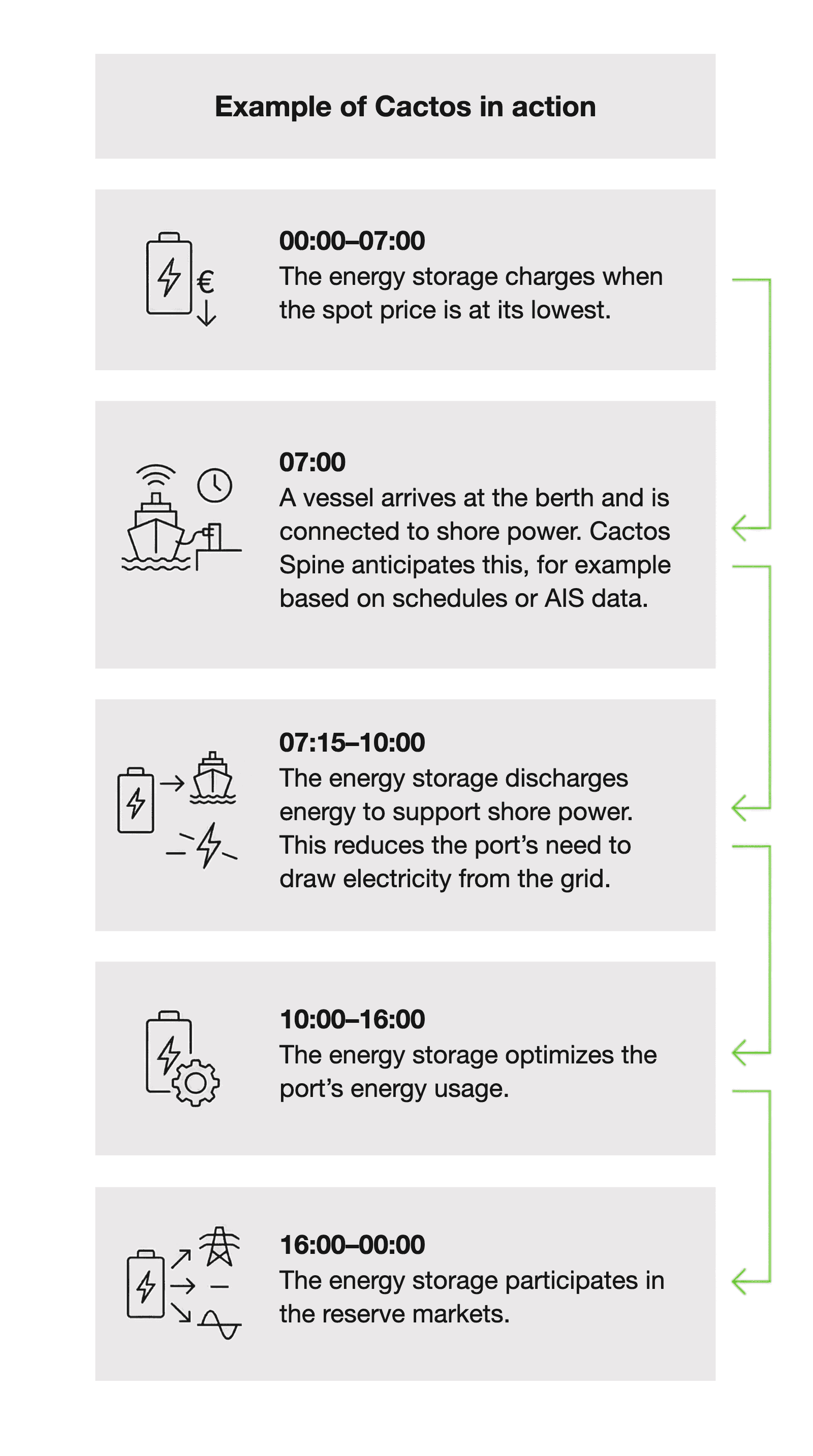
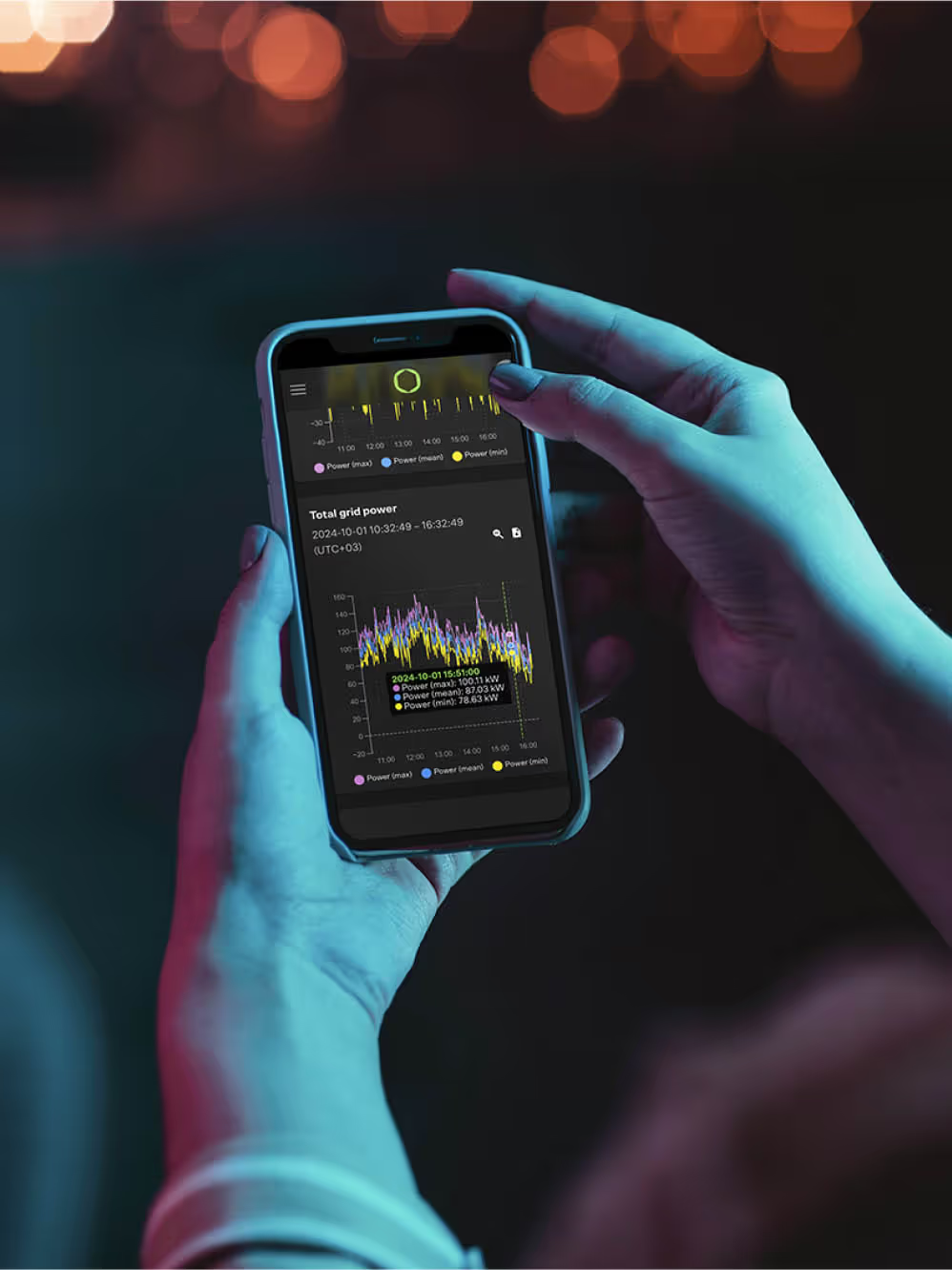
The Cactos energy storage system works automatically in the background, ensuring your port always uses electricity in the most cost-effective way. This is handled by the Cactos Spine control software without any action required from you.
When electricity is cheap, the energy storage charges. Before a vessel arrives, Cactos anticipates the need and automatically begins discharging to support your shore power system. When no vessels are connected, it optimizes your port's electricity use in other ways: for example, by shifting consumption to the battery when the electricity price rises.
The energy storage also participates in ancillary service markets, generating additional revenue even when there are no other demands.

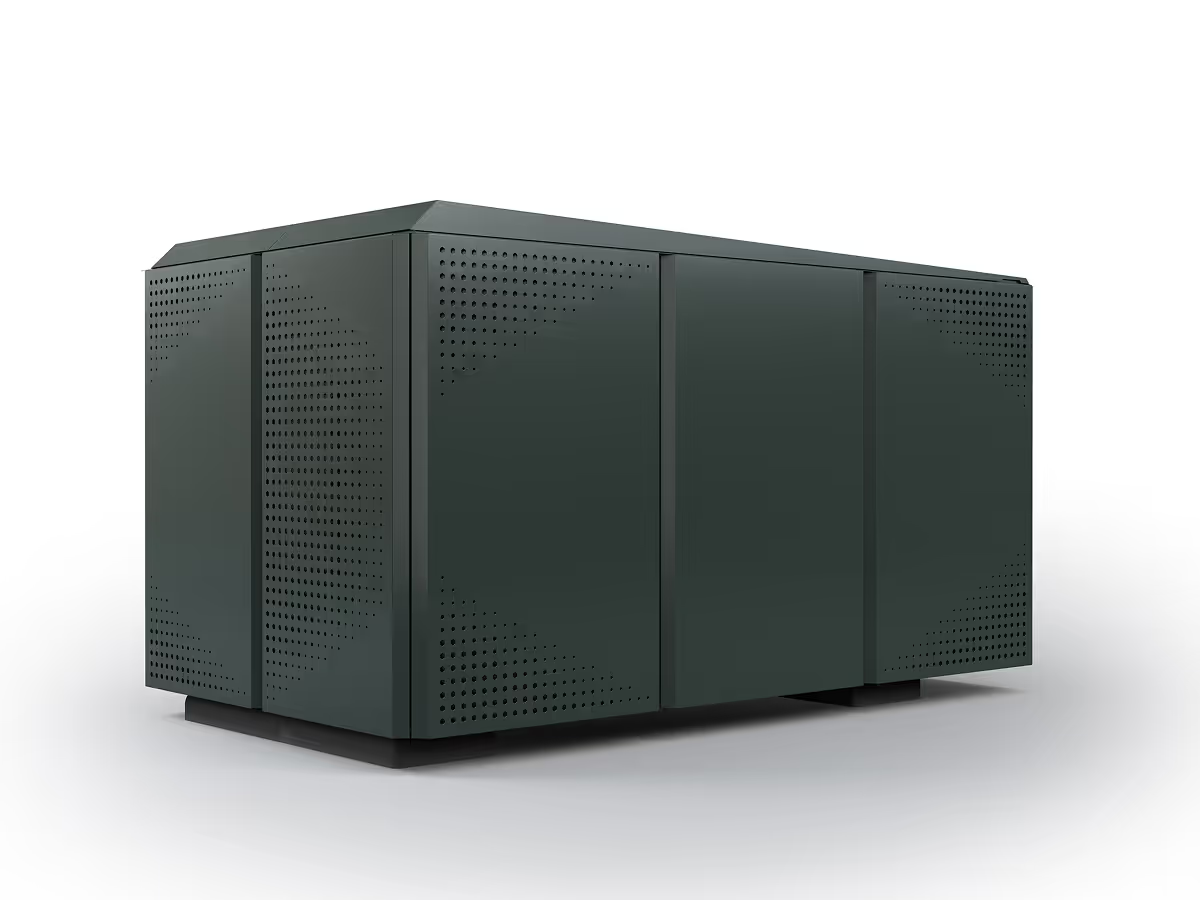
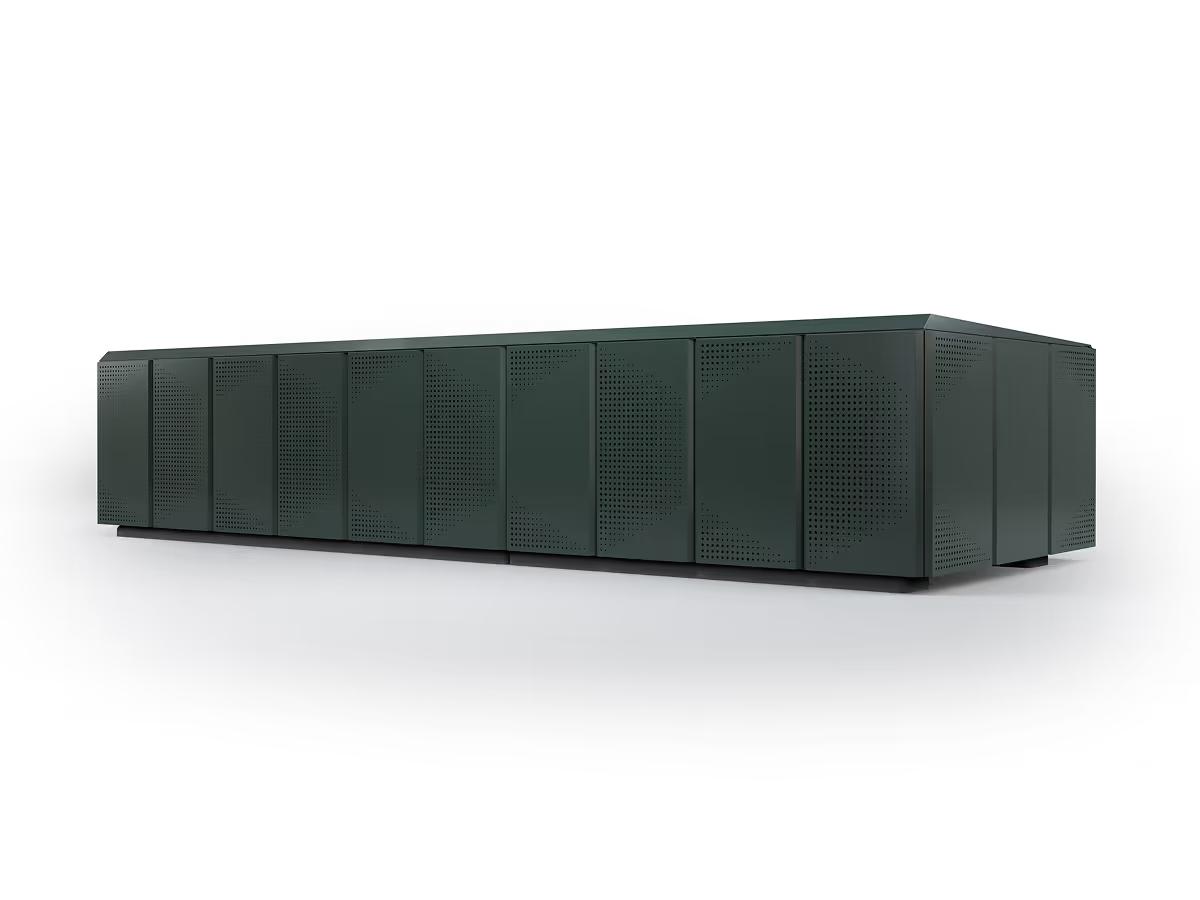
Mylo is a next-generation liquid-cooled energy storage system suited for facilities with a power requirement of 0.5–2 MW. Multiple Mylo units can be installed in parallel to achieve the required system power.
Nevado is a liquid-cooled energy storage system developed for large-scale projects. It is designed to operate reliably even under the most demanding conditions.
Available in three versions with a power output of over 2 MW and a capacity of over 4 MWh per unit. By combining multiple units, the system can be scaled up to 50 MWh.

Wondering if your port is ready for 2030? Contact us and we'll review your port's needs and produce a concrete calculation.
.png)

.png)
.png)


We operate and optimise a fleet of over 300 energy storage systems around the clock using weather forecasts, advanced algorithms and machine learning.
With our systems, you can participate in Nord Pool wholesale markets and ancillary service markets. We are also one of the first battery storage operators on the joint transmission and distribution network congestion management marketplace in Finland, providing a significant additional revenue stream.
Participation in the electricity markets is currently available for projects in Finland. Contact us to find out about availability in your country.
In times of geopolitical uncertainty, protecting critical systems is more important than ever. Cactos systems are developed and built entirely in Finland at our factory in Kempele, with no involvement from external parties. Our systems and software are built with the latest technology and meet bank-level security to IEC 62443 standard.

Olipa kiinteistösi millainen tahansa, jokainen päivä energiamaailmassa on erilainen. Alla kerrotut hyödyt auttavat sinua suunnistamaan sähköverkossa säästäen samalla aikaa, energiaa ja rahaa. Ja vieläpä automaattisesti, sillä asiakkaana sinut ei tarvitse puuttua järjestelmän toimintaan, Cactos Spine tekee sen sinun puolestasi.
Why is it challenging to offer shore power without flexibility?
Connecting a single vessel to shore power creates an instantaneous load of up to 1–10 MW. If several vessels are connected simultaneously, the power demand increases further.
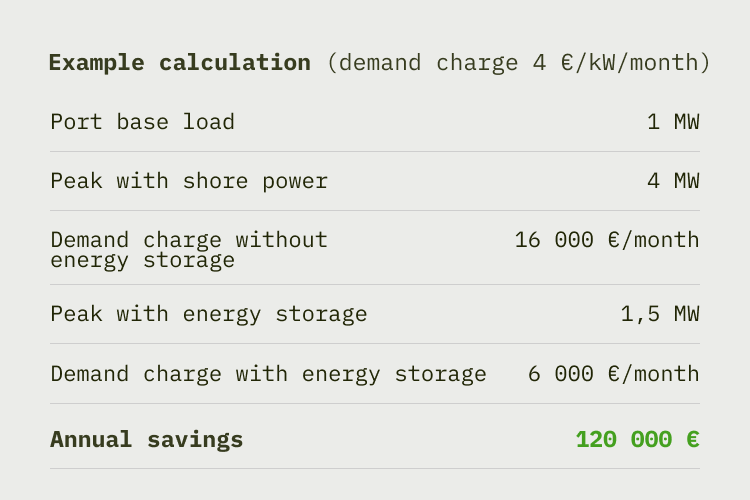
This raises the electricity transmission capacity charges for the entire month. With a battery energy storage system, part of the energy needed by the vessels can be drawn from the battery, allowing your port to save on demand charges.
Power demand can also exceed the port's grid connection capacity entirely. Upgrading the connection is a slow and costly process: permit applications, excavation works, and a new substation can easily take 2–4 years and hundreds of thousands of euros.
The battery storage acts as a power buffer that smooths out increased consumption peaks and provides additional power when the grid connection limits are reached.
What does it mean that Cactos can replace part of the shore power infrastructure?
Providing shore power requires the port to invest in a transformer (vessels use 6 kV or 11 kV voltage) and a frequency converter, since the majority of container ships operate at 60 Hz rather than Finland's grid frequency of 50 Hz. The Cactos system can, on a case-by-case basis, supply 6 kV or 11 kV voltage and 60 Hz frequency directly to the vessel from its own island mode, without a separate frequency converter or transformer investment.
What size system can Cactos deliver?
Cactos can currently deliver systems of up to 50 MWh in capacity.
What warranties and maintenance does Cactos offer?
The leasing agreement includes a 10-year full warranty. For direct purchases, the warranty is 2 years, extendable for an additional fee.
System monitoring, updates and maintenance are included in the agreement.
Contact us and we'll discuss your needs.