.jpg)
For most data centers in Finland, the answer is two hours.
Fingrid's electricity shortage protocol does not black out the country. It cuts power to areas in rotation, two hours at a time, and that is the most severe supply event the Finnish system actually plans for. It is also a measure the country has never had to use. Sizing to it means covering two hours of full facility load: when considering a battery storage solution for a 20 MW site that would mean roughly 40 to 50 MWh of battery capacity. That’s enough to ride through the worst probable event, and the same battery spends most of the year earning revenue in the wholesale electricity and ancillary services markets instead of sitting idle. In contrast, a diesel generator sized for the same event earns nothing in the meantime.
Two hours is what the protocol dictates. The separate question is whether ordinary faults and weather, the other way a site loses supply, would demand more. In Finland they rarely do.
Compared to the U.S., where customers experience roughly two hours of outages per year under normal conditions and 5 to 11 hours once major weather events are included (EIA data), Finland operates on a different standard. In urban, zoned areas where distribution networks are heavily underground-cabled and the Electricity Market Act caps weather-related interruptions at six hours, long-duration blackouts are exceptionally rare. On the national transmission level, Fingrid measures its annual interruptions in minutes.
The rest of why Finland is a highly favorable location for data centers is well documented: a naturally cool climate, an educated workforce, and modern infrastructure. Facilities can also sell waste heat into local district heating networks, which turns a thermal byproduct into a revenue stream. Furthermore, the government has signaled a new investment support scheme for data centers to be introduced this autumn in 2026.
This article examines the backup power needs of data centers in Finland, set by how the grid behaves, and compares battery storage with diesel generators.
How much backup power is actually necessary? Instead of sizing for a theoretically infinite outage based on foreign grid vulnerabilities, operators should size for the most severe event that is actually likely at their site.
In Finland, that event is a national power shortage, and Fingrid's protocol for one is specific about duration. It instructs distribution companies to cut power to areas in rotation, two hours at a time as a rule, until supply and demand are back in balance. Two hours is therefore the design number the Finnish system itself dictates.
Finland has never actually had to implement shortage-driven rotating cuts. The closest call was the winter of 2022 to 2023, when Fingrid publicly warned of the possibility after Russian imports ended and the Olkiluoto 3 nuclear plant was delayed. The system held, and Olkiluoto 3 has since added 1.6 GW of firm capacity. Sizing to the two-hour cut means sizing to a scenario the grid operator has planned for in detail but has not yet needed.
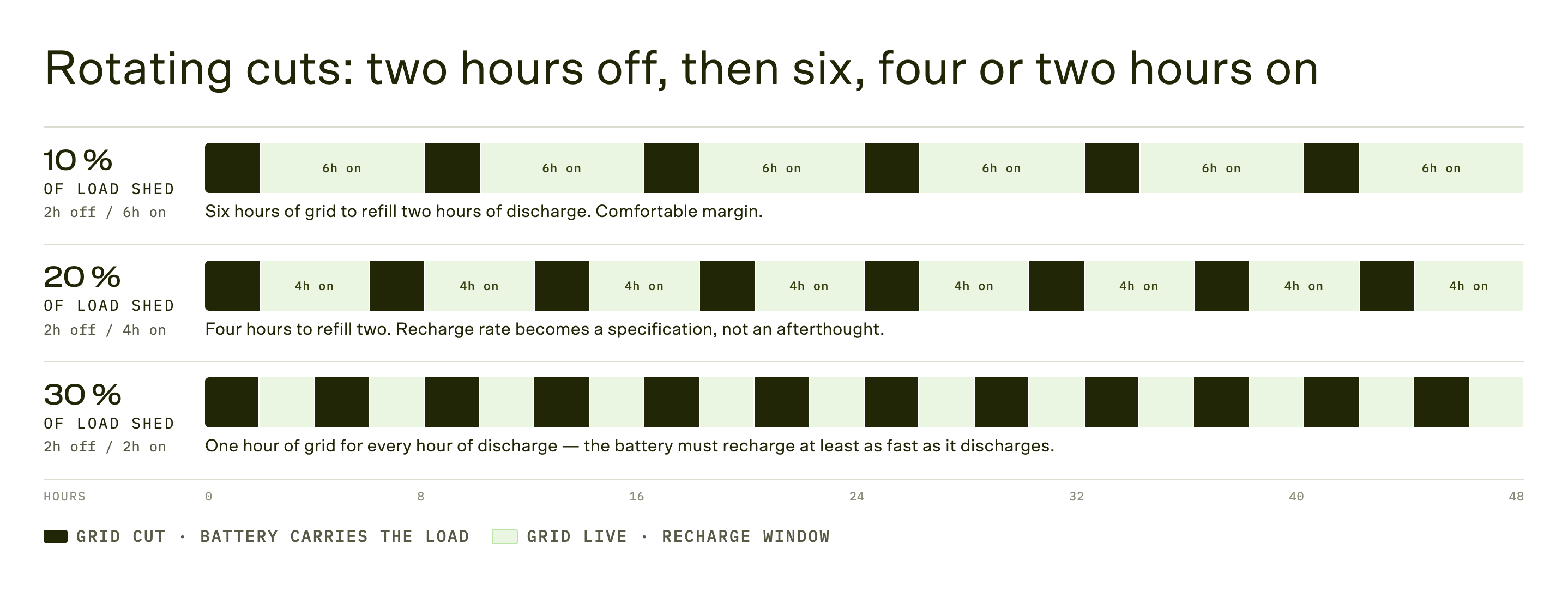
Two details matter for turning that number into a specification. First, the cuts rotate. Fingrid's planning rhythms are two hours off followed by six, four, or two hours on, depending on whether 10, 20, or 30 percent of the load must be shed. A shortage can last for days. The battery must recharge within that on-window during the hours when the grid is live but tight. Second, the two hours must cover the full facility load, not just the IT load (2 hours multiplied by the sum of IT, cooling and other facility overhead). For a 20 MW site, that is roughly 40 to 50 MWh of storage, a large but entirely standard installation. Both parameters are modelled site by site.
For AI model training, batch processing, and high-performance computing workloads where a managed pause is acceptable through checkpointing, a Battery Energy Storage System (BESS) sized this way covers the most likely severe scenario. Multi-day diesel reserves for these workloads tie up substantial CapEx against an event the local grid is designed to avoid. Longer local faults (like a substation fire or a damaged cable) remain possible, and each operator should weigh them in its own risk assessment.
The objective is to base that assessment on the local grid rather than on habits imported from more volatile regions.
For example, the graph below shows the distribution of power outage durations at Cactos customer sites in Finland between January and August 2026. Of the interruptions recorded, more than half were over within two minutes, and 83 percent within fifteen. The median interruption lasted 2 minutes.

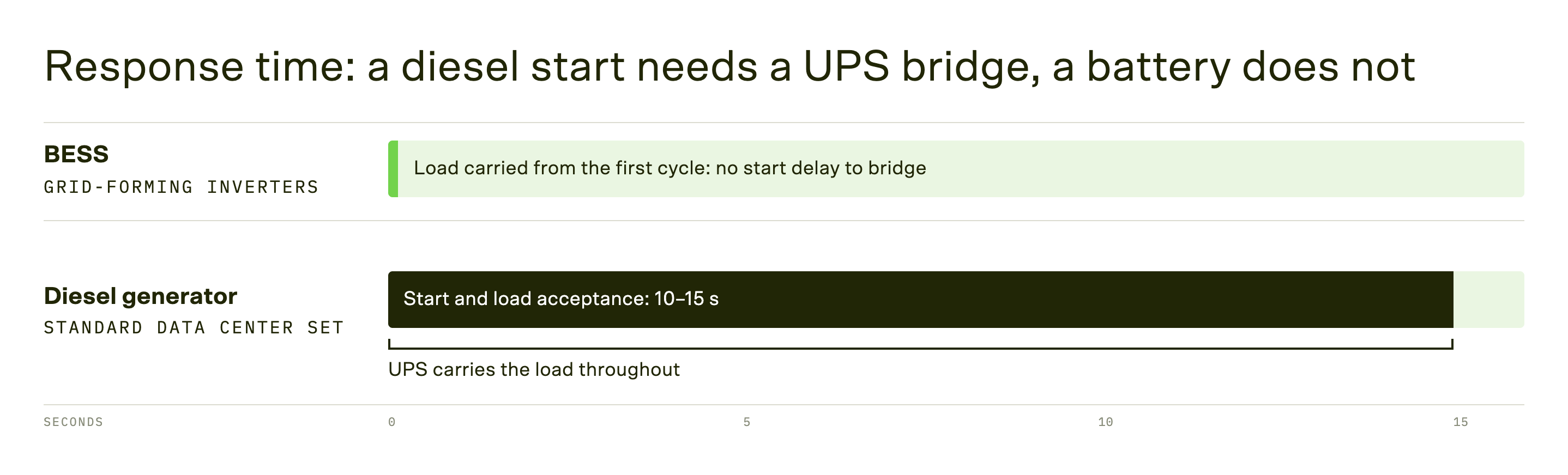
Modern BESS technology changes traditional facility design. A standard data center diesel generator takes 10 to 15 seconds to start and accept load, which requires a separate UPS layer to bridge the gap and cover failed starts. A BESS equipped with grid-forming inverters responds near-instantaneously, allowing operators to downsize traditional UPS systems rather than over-engineering them to bridge long startup delays.
In urban and brownfield sites (previously developed land rather than a fresh plot), diesel generators also bring friction: environmental permitting, noise constraints, bulk fuel logistics, and routine test runs that consume OpEx. A large lithium battery has its own requirements, mostly chemical-safety notification and fire-safety design agreed with the local rescue department. However, the permitting footprint is lighter, and there is no fuel to store, handle, or burn.
A diesel generator is a depreciating insurance policy: it consumes capital through maintenance and produces nothing until the day it is needed. In contrast, when operated through a proprietary energy management and optimization software, like Cactos Spine, a battery participates in wholesale electricity and ancillary services markets every hour when it is not needed for emergency backup. This generates active revenue that directly offsets its own cost.
In addition, backup capacity should be managed dynamically. A national power shortage requiring a two-hour rolling blackout does not strike without warning: it is forecasted hours or even days in advance. During normal grid operations, optimization software can relax the absolute two-hour backup capacity limit, freeing up capacity to participate in the reserve and wholesale markets while maintaining a smaller buffer for sudden, short-duration local faults.
When grid forecasts indicate a tightening supply, the software automatically charges the system and locks in the full two-hour or any agreed-hour backup capacity well before any shortage protocol is initiated. This intelligent forecasting maximizes market revenue without compromising facility protection.
For operators who want active backup without building an internal energy trading desk, look for different commercial models your supplier might offer:
Cactos is an example of a provider providing all three models based on the client’s needs and wishes.
If you need help calculating the backup duration and storage size for your facility, contact your local expert or Cactos energy advisors to see how a market-integrated battery lowers your energy costs.
.jpg)
.jpg)

