
Across Europe, grid-scale battery energy storage systems (BESS), also called utility-scale storage, are being deployed at scale to capture value in electricity wholesale markets and ancillary services. As the market matures, the hard question for BESS project developers and investors is shifting from whether to build to who to build with.
The short version: choosing among large-scale BESS suppliers is not just a hardware procurement exercise. It is a decision about who will design, deliver, qualify, operate, and monetize an asset over a 15 year life, and who will still be standing behind the warranty in year eight.
To figure out the answer, assess a grid-scale BESS supplier on five things: whether their system archetype matches your grid connection, how fast they can actually deliver, how much of the hardware-software-market chain they own, where the hardware and control software come from, and whether they are able to stand behind the system for the whole warranty period. Each area is covered below, with thirteen questions to put in your RFP at the end.
Start with the project, not the product
Time to market: the most underpriced variable
A fully integrated technology stack and why it matters for revenue
European supply: quality, cybersecurity, and the direction of regulation
Bankability: who stands behind the asset in year eight?
Where Cactos is not the right answer
Thirteen questions to ask a grid-scale BESS supplier
Start from your grid connection and revenue model, not from a container spec sheet: they determine which supplier archetype fits.
Broadly, the European market has settled into two camps:
Large high-voltage (HV) projects. Large installations of 100 MW and above, connected to the transmission system operator’s (TSO) HV grid. These are bespoke engineering projects: HV transformers, HV switchgear, project-specific grid studies, type C/D grid code compliance (EU grid codes rank units A to D by size and connection voltage, with heavier technical requirements at each step), and long interconnection queues. Lead times for HV infrastructure alone frequently run to multiple years.
Small to medium grid-scale projects on the medium-voltage (MV) grid. Typically one to ten megawatts, connected at distribution system operator (DSO) level. These projects are often overlooked in industry commentary, yet in many European markets they combine the best of both worlds:
Neither camp is universally "better", but the supplier that excels at 200 MW TSO-connected megaprojects is rarely the supplier that delivers a 10 MW medium-voltage project quickly and economically, and vice versa.
Cactos, a Finnish BESS manufacturer and operator, deliberately specializes in the second category: standardized small-to-medium grid-scale projects connecting to the medium-voltage grid. That specialization shapes everything else in this article, and we will be transparent about where it fits, and where it does not.
In today's European power markets, delivery speed is worth more than most procurement processes price it at. Prices in the ancillary services markets and wholesale volatility are attractive now, and every quarter a project spends in engineering or permitting is a quarter it earns nothing. Those conditions are not guaranteed to last either: merchant revenue projections beyond a few years carry real uncertainty as more storage capacity enters each market.
When assessing suppliers on delivery speed, look past the quoted equipment lead time and ask about the whole chain:
A supplier that answers all three of these well is rare. A supplier that answers none of them is quoting you an equipment lead time and calling it a project schedule.
For reference on what is achievable in the medium-voltage segment, Cactos’ model is built around this logic. Cactos delivers projects from order to commercial operation within a maximum of nine months, single-party, because each site repeats the same hardware, the same software, and the same qualification path. Full turn-key EPC delivery, long-term operation, maintenance, and market trading are handled by one party. This makes delivery timelines short and predictable compared to multi-vendor project structures.
For projects targeting electricity wholesale market participation and ancillary services, the software and market-access layer determines the return at least as much as the hardware does.
The typical fragmented structure (hardware from one vendor, EMS from a second, trading and optimization from a third) creates three problems:
Cactos provides the entire chain in-house: the Nevado hardware platform designed and manufactured in Finland, embedded control software, and the Spine platform for trading, dispatching, operation, and monitoring. The same stack runs on every project in the fleet.
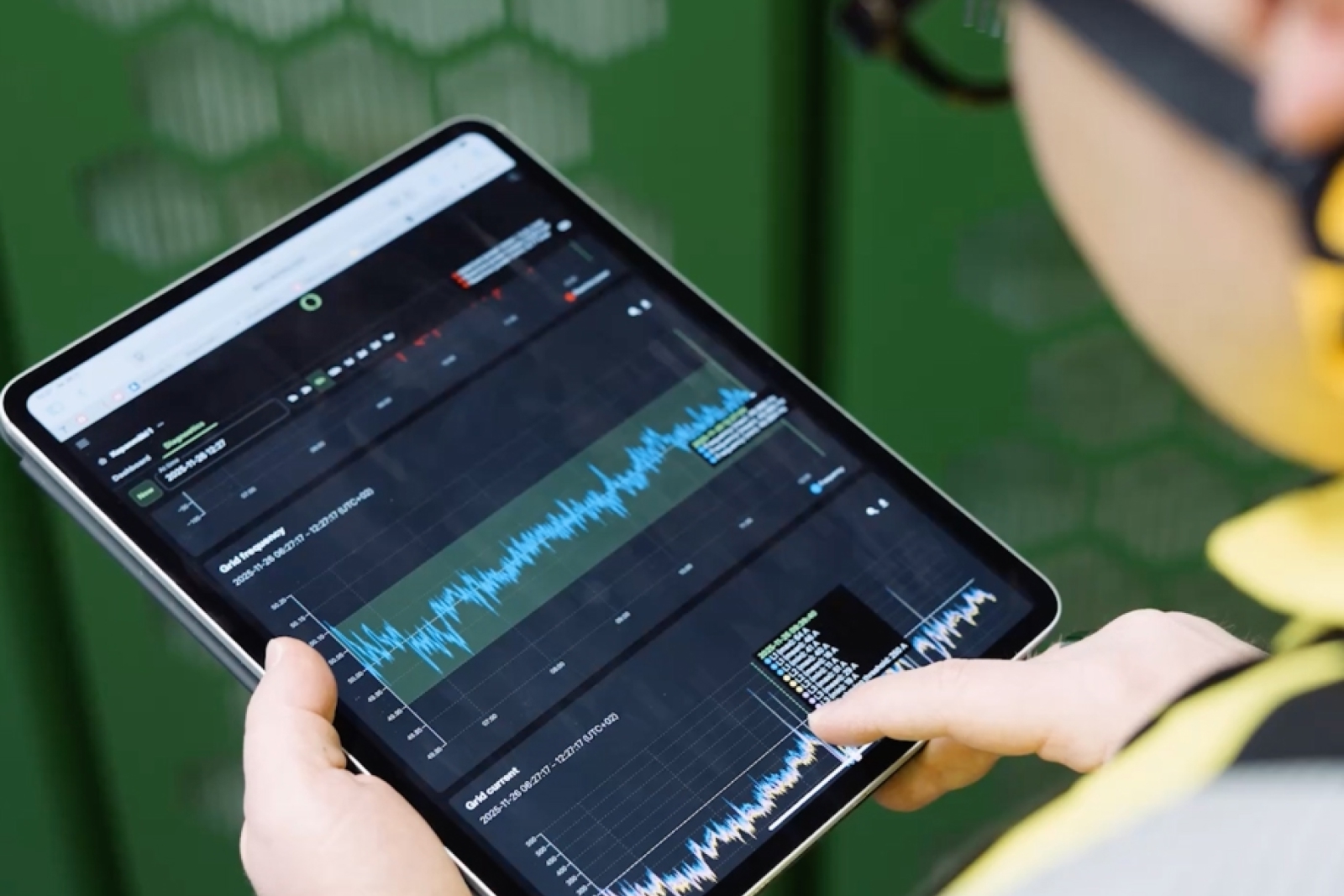
Two consequences matter for buyers:
Simplified TSO and market qualification. Because the identical stack has passed prequalification repeatedly, bringing a new site into reserve markets is a repetition and not an iterative process. Most importantly, the documentation is up-to-date and readily available. Cactos systems participate in the ancillary services markets across the Nordics.
Direct market access. Cactos is a balance responsible party (BRP) and trades using its own balance. There is no dependency on a third-party optimizer's priorities, fee stack, or portfolio conflicts. The party that built the system, operates it, and answers for its performance is the same party bidding it into the market.
For an investor, this collapses a chain of counterparties into a single accountable one, which simplifies not only operations but also the legal structure of the investment itself.
The trade-off: concentration risk. Integration goes both ways, and the objection deserves a straight answer. A fragmented supply chain lets you replace one link without touching the others: if the optimizer underperforms, you change the optimizer and the batteries keep running. With a single-party stack, hardware, software, market access, and O&M share one counterparty, and you can’t really change your mind later about any single element.
That risk is managed rather than eliminated. What matters is knowing what happens to the system, the data, and the market access if the supplier is no longer there. Question 13 below is the one to press hardest on, whichever supplier model you choose.
Where the hardware and the control software come from is now a risk question, not only a cost question. Most grid-scale battery systems installed in Europe today are built around hardware and control software from outside Europe. That has been a rational cost decision, but the risk picture is shifting, and buyers have started asking about it directly.
Cybersecurity. A grid-connected BESS is remotely controllable industrial infrastructure. It receives dispatch commands, runs vendor firmware, and in most architectures maintains a permanent connection to a vendor cloud. The questions to ask any supplier: Where is the control plane hosted? Who can push firmware to the site, and from where? What happens to the system if the vendor's cloud or the vendor itself becomes unavailable? Can remote access be audited and restricted (without impacting warranty)? Is the system built to a recognised industrial cybersecurity standard such as IEC 62443, and is that compliance independently certified or self-declared?
Regulatory trajectory. The direction of European regulation is clear. NIS2 extends cybersecurity obligations deep into the energy sector, and grid operators and member states are paying increasing attention to the security implications of foreign-controlled firmware and cloud dependencies in grid infrastructure. A supplier choice that is compliant today may carry retrofit or reporting burdens tomorrow. European battery storage vendors with European control planes start from a structurally easier position. For example, Cactos develops and operates its full software stack in-house, from the battery management system (BMS) to embedded control system and EMS, and even the printed circuit boards are manufactured in Finland.
Quality and environment fit. Northern European sites impose thermal management, cold-start behaviour, and enclosure demands that many systems are specified for but few have proven at scale. Ask for the operating range, and then for operational data from sites that have actually seen it. Cactos systems are designed and manufactured in Finland and engineered for demanding conditions: they operate from −30 °C to +45 °C, are liquid-cooled, and the operational fleet includes deployments in harsh environments.
None of this means non-European hardware cannot be deployed responsibly. It means the assessment must go beyond the price per kilowatt-hour, and that the compliance burden of proving a foreign-controlled system safe sits with the buyer.

For debt-financed projects, the supplier assessment ultimately runs through a lender's independent engineer, and their questions are strictly practical:
Cactos comes to this conversation with roughly 150 MWh deployed and operational across grid-scale and commercial and industrial sites in Europe, a firm order backlog of the same magnitude, and institutional investor backing. The company builds, owns the technology of, operates, and trades its fleet, meaning its own economics depend on the same long-term performance its customers' economics do. Alignment of that kind is difficult to replicate contractually across a fragmented supplier chain.
Honesty is part of assessment, so: if your project is a centralized 100+ MW transmission-connected installation with bespoke grid studies, HV infrastructure, and project-specific engineering requirements, Cactos is not the supplier for you. That segment is served by global integrators structured around large one-off projects, and it is a legitimate model for that scale.
However, even if you are looking to deploy 100 MW, it may make sense to investigate deploying it across multiple smaller sites. In some cases splitting a large BESS into smaller pieces makes for lower cost and faster execution, IceCreek Energy’s 90 MWh portfolio built by Cactos being a good example.
Cactos's specialization is the medium-voltage segment: standardized multi-megawatt systems, delivered turnkey at speed, qualified into reserve and wholesale markets on a proven stack, and operated and traded over the long term by the same company that built them.
The difference is where the system connects to the grid. A high-voltage (HV) project connects typically at 110 kV or above to the national grid run by the transmission system operator (TSO). A medium-voltage (MV) project connects at 10–35 kV to the local grid run by the distribution system operator (DSO). Under EU grid codes, MV projects generally fall into the lighter type B compliance category. The result is lower connection cost, simpler permitting, and substantially shorter delivery timelines, at project sizes that still support meaningful wholesale and ancillary services market revenue.
European grid codes classify units as type A, B, C or D by capacity and connection voltage. Requirements increase at each step: higher classes face more demanding technical capabilities, more testing, and heavier compliance documentation. Thresholds differ between synchronous areas: for example, the Nordics and Continental Europe have different limits. For a buyer, the practical consequence is that a type B project is often faster and cheaper to qualify than a type C or D one.
With a standardized system and a single-party delivery model, a medium-voltage project can reach commercial operation within a year: Cactos delivers projects within nine months from order. The dominant variables are grid connection availability and local permitting, which is one reason experienced suppliers assess the connection before anything else.
The main streams are frequency and balancing reserve products procured by transmission system operators (such as FCR, aFRR, and mFRR), wholesale arbitrage across day-ahead and intraday markets, local flexibility markets (such as FinFlex), and imbalance optimization. The optimal mix shifts continuously with market prices, which is why the trading and dispatch layer, and the operator's ability to move between markets, matters as much as the hardware.
A balance responsible party (BRP) is an entity financially responsible for its own imbalances toward the transmission system operator (TSO) and able to trade in its own name. A supplier that is also a BRP, as Cactos is, can trade the asset directly on its own balance rather than routing through third-party intermediaries, removing a layer of fees, dependencies, and conflicting portfolio interests between the asset and the market.
Reserve products require prequalification: the TSO tests that the full chain (market interface, dispatch software, controls, and battery) responds within strict tolerances. A supplier whose exact stack has already passed these tests repeatedly can qualify a new site as a routine repetition. A first-of-a-kind combination of vendors risks months of delay at precisely the point the project should start earning.
Modern LiFePO4 systems are typically rated for several thousand full cycles before capacity falls to around 70 % of original. Cactos systems are rated for 8 000 cycles to 70 % state of health, which in normal grid-scale duty supports an asset life of around 15 years. Actual degradation depends on cycling depth, temperature, and how hard the asset is traded, which is why the operating environment and the dispatch strategy matter as much as the cell specification.
Put these in your RFP. The answers will separate integrated, proven suppliers from assemblies of subcontractors.
1. Is your system standardized, or does our project require new engineering? What exactly is engineered per site?
2. What scope (hardware, EPC, EMS, trading, O&M) do you deliver yourselves, and what is subcontracted or left to third parties?
3. How many times has this exact hardware-plus-software configuration been deployed and commissioned?
4. Are you a balance responsible party? Do you trade on your own balance or through a third-party optimizer?
5. Which reserve and wholesale markets will our asset participate in, and how is the revenue split structured?
6. Where is your control plane hosted, and who can push firmware or dispatch commands to our site?
7. How does the system behave if your cloud services are unreachable? Is there a documented fallback mode?
8. How do you comply with NIS2 and applicable national cybersecurity requirements for grid-connected assets? Is the system built to IEC 62443 or an equivalent standard, and is that certified?
9. Where is the hardware designed and manufactured, and how is quality controlled through the supply chain?
10. What capacity, degradation, and availability guarantees do you offer and does one party carry liability across the full chain?
11. What is your operational track record in a climate comparable to our site?
12. What is your current deployed base and firm order backlog, and what is your financial position?
13. If our commercial relationship ends, what happens to the software, market access, data, and warranties on our asset?
Choosing among large-scale BESS suppliers is ultimately a choice of operating partner, not equipment vendor. For European battery energy storage system project developers and investors targeting the medium-voltage segment, the shortest path to a bankable, revenue-generating asset is a standardized system from a supplier that has built, qualified, and traded the same stack many times before, and stakes its own business on the fleet's performance.


